
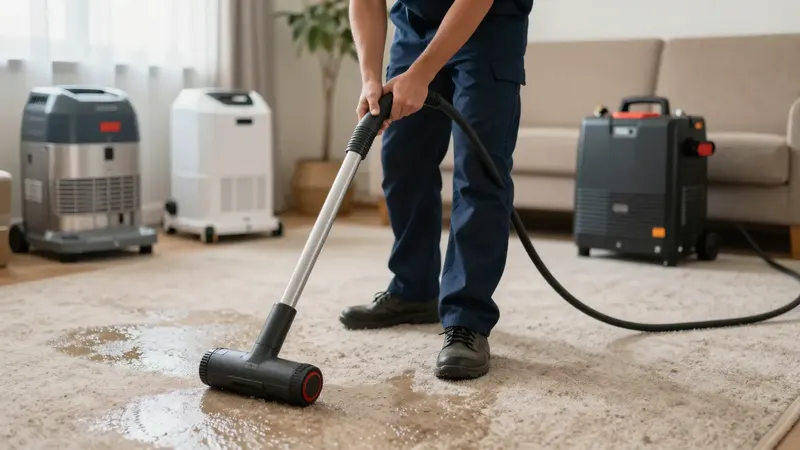
Water extraction is a narrow, mechanical task: getting liquid water out of the building before relying on evaporation. Fans and dehumidifiers can only remove moisture so quickly, so a contractor who pulls more water out with vacuums and pumps at the start leaves far less for the drying equipment to handle. People searching this term often have soaked carpet, a flooded basement, or inches of water on a hard floor.
Fire & Water Energy is a referral service; we don't operate extraction equipment or employ crews. Call (866) 937-3230 and we'll try to connect you with an independent restoration contractor in your area who has extraction equipment; availability varies by location. See How It Works for details.
Where Extraction Comes Into Play
- Wall-to-wall carpet and pad soaked by a supply line, toilet overflow, or appliance leak.
- Basements and crawl spaces holding standing water after heavy rain or a sump pump failure; see basement flood cleanup.
- Hard floors such as tile, vinyl, or concrete with pooled water.
- Flood water extraction after outside water entered the home, which is treated as contaminated and usually paired with flood cleanup.
- Water trapped under flooring or in wall cavities, where specialty tools may be used.
EPA notes that mold can grow on materials such as carpet and drywall that stay wet for more than a day (EPA flood cleanup guidance), which is why getting bulk water out early matters.
Common Extraction Equipment
Contractors commonly bring a mix of tools depending on depth and surface:
- Submersible pumps for deeper standing water, often in basements.
- Truck-mounted or portable extraction units with strong vacuum for carpet and shallow water.
- Wands and squeegees for hard floors and carpet.
- Weighted or ride-on extractors that compress carpet and pad to squeeze out absorbed water.
- Moisture meters and thermal cameras to find wet areas the eye can't see.
A Typical Extraction Sequence
- Hazard and category check. The crew confirms power to wet areas is safe and judges whether water is clean, gray, or Category 3 (grossly contaminated).
- Contents moved. Furniture is lifted or relocated so floors can be reached.
- Bulk removal. Pumps or vacuums remove standing water.
- Carpet decision. Clean-water carpet may be extracted in place; pad is often removed. Carpet soaked by sewage or floodwater is usually discarded.
- Repeated passes. Multiple slow passes pull more water than one quick pass.
- Moisture mapping. Readings around the perimeter show how far water wicked into walls.
- Handoff to drying. Air movers and dehumidifiers are set up; see structural drying.
Need help with water extraction?
Call (866) 937-3230 and tell us what happened and where.
Staying Safe Around Standing Water
Standing water can hide hazards. Ready.gov warns not to touch electrical equipment that is wet or when you are standing in water, and to shut off electricity only if it is safe (Ready.gov: Floods). Do not step into a flooded basement where outlets, a furnace, or a water heater are submerged.
- Avoid contact with water from outside flooding or sewage; wear rubber boots and gloves if you must enter, as CDC recommends for cleanup.
- Don't use a standard household vacuum on water.
- Return to a flooded home only when authorities say it is safe, and keep children out of cleanup work.
- Keep gas-powered pumps and generators outdoors because of carbon monoxide.
Leave the building and call 911 if you notice sparking, a gas smell, or a sagging ceiling.
Records Worth Keeping
Coverage depends on your policy; your insurer or agent can tell you what applies. Before extraction starts, photograph the water depth against a wall or furniture leg so the extent is clear later. Ask the contractor to note how much carpet and pad were removed and why. FEMA's FloodSmart guidance suggests keeping samples of damaged carpet and flooring for flood claims, so ask the crew to leave a small piece for your records.
Questions for an Extraction Contractor
- Do you hold the license, if any, that our state requires for this work, and can you show proof of insurance?
- What extraction equipment will you use, and will you use weighted extraction on the carpet?
- How do you decide whether carpet and pad can be saved or must be removed?
- Does the crew on my job hold IICRC certification and follow the S500 standard?
- Will I receive moisture readings and a written estimate before drying equipment is billed?
Extraction Versus Emergency Removal and Drying
Emergency water removal covers what you and a contractor do in the first hours overall, including shut-offs and safety. Extraction is the specific step of removing liquid water with equipment. Structural drying deals with moisture that remains inside materials after extraction. All three fall under the broader water damage restoration process.
Frequently asked questions
Can my carpet be saved after water extraction?
Sometimes. Carpet wet with clean water and extracted promptly can often be dried in place, though the pad is frequently replaced. Carpet soaked with sewage or floodwater is usually discarded because it cannot be reliably disinfected.
Is a shop vac good enough for water extraction?
A wet/dry vacuum can handle small amounts of clean water on hard floors. It removes far less from carpet and pad than professional extraction equipment. For larger areas or soaked carpet, professional equipment generally leaves less water behind for drying.
What is flood water extraction?
It refers to removing water that entered the home from outside, such as rising water or storm runoff. That water is treated as contaminated, so crews use protective gear and porous materials are often discarded. Our flood cleanup page covers the broader process.
Why do they still need fans after extracting the water?
Extraction removes liquid water, but materials like drywall, wood, and subfloor still hold moisture inside them. Air movers and dehumidifiers draw that moisture out over the following days. According to EPA, drying a home after flooding typically runs from several days to a few weeks.
How deep does water need to be to call for extraction?
There is no fixed depth. Even a thin layer that soaked into carpet and pad across a room can hold a large amount of water. If water covers more than a small area or reached walls and flooring seams, extraction is worth discussing with a contractor.
Related services
Find water extraction help by state
- Florida
- Georgia
- Texas
- Louisiana
- Alabama
- Mississippi
- California
- South Carolina
- North Carolina
- Tennessee
- Arizona
- New Mexico
- Virginia
- Maryland
- Oregon
- Washington