
As the seat of Collin County, McKinney combines a courthouse square whose oldest landmark dates to the 1870s with large newer subdivisions spreading across the Blackland Prairie. That mix means property owners deal with everything from aging plumbing near downtown to roof and drywall damage in recently built homes.
Fire & Water Energy does not perform repairs; we make referrals. Phone (866) 937-3230 and we will try to reach an independent restoration company that takes jobs in McKinney and neighboring towns such as Allen and Prosper. Whether anyone can take the job depends on local providers. Learn about the process on how it works and in our referral disclosure.
Prairie weather that tests McKinney roofs and pipes
The city sits around 577 feet above sea level in a humid subtropical climate. Spring is the rainiest season as Gulf moisture streams north, and measurable rain falls on roughly 78 days a year. Snow averages only a couple of inches, yet temperatures have dipped to 7 degrees below zero (1930) and soared to 118 degrees (1936).
Federal disaster declarations that included Collin County since 2000 cover Hurricane Rita (2005), the 2006 Extreme Wildfire Threat, the 2007 Severe Storms, Tornadoes, and Flooding, the 2021 Severe Winter Storms, and the 2024 Severe Storms, Straight-line Winds, Tornadoes, and Flooding. The county is also updating its hazard mitigation plan, which addresses floods and wildfires.
Common leak sources in McKinney homes
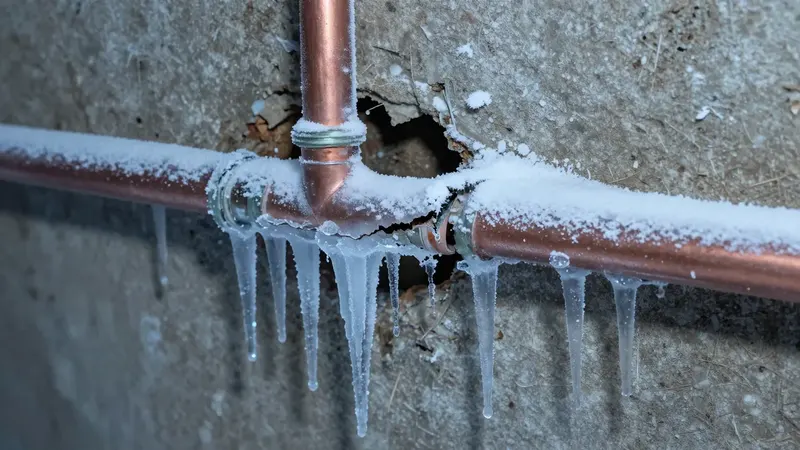
Sudden cold snaps are a leading cause of burst lines in attics, garages and exterior walls; the February 2021 freeze is the clearest recent example. In warmer months, slab leaks under foundations, failed water heater tanks, AC drain lines that back up and supply hoses on washers and refrigerators cause most indoor water problems. Heavy spring rain can also exploit worn shingles and flashing.
When people look for water damage restoration in McKinney, they typically need a company that can shut off the source, extract water, map moisture behind baseboards and dry the structure with commercial equipment. Read about burst pipe water damage and water damage repair to see what that work involves.
Federal disaster declarations that included Collin County
FEMA records show Collin County was included in 5 major disaster declarations for weather or fire events from 2000 through 2026 (1 flood, 1 severe ice storm, 1 severe storm, 1 fire, 1 hurricane, by FEMA incident type). Declarations are made at the county level, so they do not mean every neighborhood in McKinney was affected. The most recent:
- 2024 – Severe Storms, Straight-line Winds, Tornadoes, and Flooding (DR-4781)
- 2021 – Severe Winter Storms (DR-4586)
- 2007 – Severe Storms, Tornadoes, and Flooding (DR-1709)
- 2006 – Extreme Wildfire Threat (DR-1624)
- 2005 – Hurricane Rita (DR-1606)
Source: OpenFEMA Disaster Declarations Summaries, retrieved 2026-10-10. Counts include major disaster (DR) declarations with hurricane, flood, severe storm, tropical storm, fire, tornado, coastal storm, winter or ice storm, mudslide and dam/levee incident types.
Water, fire or storm damage in McKinney?
Call (866) 937-3230 and tell us what happened at your McKinney property.
Fire and smoke cleanup, from the historic square to new builds
Structures around the downtown square, including the old county courthouse begun in 1874, reflect building methods that differ from today's. Older plaster, wood trim and original floors absorb soot differently than modern drywall and engineered materials, and contractors often adjust cleaning methods accordingly. In newer houses, synthetic furniture and carpet tend to produce heavy, oily smoke residue.
A typical fire job starts with boarding up and making the space safe, then removing charred debris, cleaning surfaces and HVAC ducts, and treating lingering odor. Our fire damage restoration and soot removal guides describe these steps.
Severe spring storms and flash flooding in Collin County
Most of the area's damaging weather arrives with spring thunderstorms that can bring hail, strong straight-line winds and tornadoes, as reflected in the 2007 and 2024 federal declarations. Fast-rising water in low spots and along drainage channels can reach garages and ground floors in a short time.
After a storm, contractors usually prioritize tarping roofs and covering broken windows, then turn to drying interiors. Water that flowed in from outside is handled as contaminated, which often means removing wet carpet pad and the bottom section of drywall. See storm damage cleanup and flood damage restoration for more.
Keeping mold out after a leak or storm
North Texas summers are hot and sticky, and wet drywall, insulation or carpet can start growing mold in as little as 24 to 48 hours. Hidden moisture from a slow slab leak or a roof drip into the attic is a frequent culprit because it goes unnoticed for weeks.
EPA guidance says that patches under roughly 10 square feet can often be cleaned by a homeowner after the water problem is fixed. Larger spreads, growth inside walls or HVAC systems, and anything tied to sewage usually need professional mold removal.
Checklist for McKinney property owners
- Dial 911 if there is fire, a gas smell, injuries or electrical hazards.
- During a tornado warning, get to an interior room on the lowest level away from windows.
- Close the main water valve when a pipe splits, and keep people away from sagging ceilings.
- Photograph damage room by room before cleanup and save receipts for emergency purchases.
- Contact your insurance agent or company to learn what your specific policy covers.
- Share local hazard experiences through the Collin County hazard mitigation survey.
Neighborhoods and nearby communities
Areas in and around McKinney that callers often mention include:
- Downtown McKinney
Nearby communities with their own pages (straight-line distance from McKinney):
McKinney restoration FAQs
What month brings the most rain to McKinney?
May is typically the wettest month, and spring overall is the rainiest season. That is also when severe thunderstorms with hail and high winds are most frequent, so it is a good time to have gutters and roofing checked beforehand.
Do pipes really freeze in McKinney?
They can. The record low is minus 7 degrees, and the 2021 Severe Winter Storms led to a federal declaration for Collin County. Insulating attic and exterior pipes and knowing where your main shutoff is can limit damage.
Are older homes near the downtown square harder to restore after smoke damage?
They can need a gentler approach. Historic finishes such as plaster and original wood absorb soot differently than modern drywall, so ask any contractor how they plan to clean those materials before work starts.
Is Collin County planning for floods and wildfires?
Yes. The county is updating its hazard mitigation plan, which covers natural hazards such as floods and wildfires, and has asked residents to fill out a public survey.
How does a referral through Fire & Water Energy work?
You call (866) 937-3230, describe the damage, and we try to connect you with an independent contractor that serves McKinney. We do not do the work and cannot guarantee that a provider will be available.
Restoration guides
- Burst Pipe Water Damage
- Water Damage Repair
- Storm Damage Cleanup
- Fire Damage Restoration
- Soot Removal
- Mold Removal