
Bend straddles the Deschutes River, which is dammed in town to form Mirror Pond, and the Pilot Butte cinder cone rises within city limits. The Deschutes National Forest presses against the southwest edge of the city, and the Horse Lava Tube System reaches its eastern side.
Fire & Water Energy is a referral service that tries to steer callers toward independent restoration contractors; we don't own equipment or employ crews. Reach us at (866) 937-3230 if a frozen line, roof leak or fire has damaged your property, and we'll look for a company that takes work in Bend, subject to who is available nearby. The details sit on our how it works page and the referral disclosure.
High-desert extremes: cold nights, snow and fire weather
Wikipedia classifies Bend's climate as cool semi-arid, with only about 10.6 inches of precipitation and close to 22 inches of snow in a typical year. Using 1981–2010 normals, the freeze window runs from September 13 to June 19, and hard frost is possible even in summer. The record low is −26°F, reached in 1933 and again in 1950, and the record high of 107°F was set on June 30, 2021. The 1973–74 season dumped 90.6 inches of snow.
Deschutes County has been included in three FEMA major disaster declarations since 2000: severe winter storms in 2004 (DR-1510), winter storms with flooding, landslides and mudslides in 2017 (DR-4328), and wildfires with straight-line winds in 2020 (DR-4562).
Burst lines, ice dams and water damage restoration in Bend
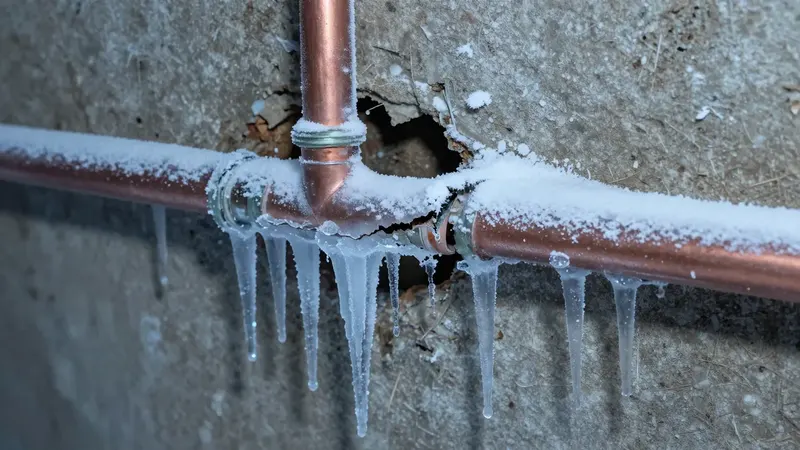
With so many months below freezing, the most common indoor flood here starts with a pipe. Lines in exterior walls, crawlspaces, garages and unheated additions are vulnerable, and the break often lets go during the thaw rather than the coldest night. Heavy snow that melts and refreezes at the eaves can back water under shingles, showing up as ceiling stains days later.
Water damage restoration in Bend generally means shutting off the supply, extracting what's on the floor, and drying framing and subfloor with dehumidifiers. Low outdoor humidity helps, but cavities still need monitoring with moisture meters. Our burst pipe water damage page covers split supply lines; roof-related leaks are discussed on ceiling water damage repair.
Federal disaster declarations that included Deschutes County
FEMA records show Deschutes County was included in 3 major disaster declarations for weather or fire events from 2000 through 2026 (2 severe storm, 1 fire, by FEMA incident type). Declarations are made at the county level, so they do not mean every neighborhood in Bend was affected. The most recent:
- 2020 – Wildfires and Straight-line Winds (DR-4562)
- 2017 – Severe Winter Storms, Flooding, Landslides, and Mudslides (DR-4328)
- 2004 – Severe Winter Storms (DR-1510)
Source: OpenFEMA Disaster Declarations Summaries, retrieved 2026-10-10. Counts include major disaster (DR) declarations with hurricane, flood, severe storm, tropical storm, fire, tornado, coastal storm, winter or ice storm, mudslide and dam/levee incident types.
Water, fire or storm damage in Bend?
Call (866) 937-3230 and tell us what happened at your Bend property.
Living next to the national forest: smoke, ash and fire damage
Because forest land borders the city, summer heat and dry fuels raise wildfire concerns, and the 2020 declaration for wildfires and straight-line winds included Deschutes County. Smoke can push fine soot through window gaps, attic vents and HVAC intakes even when no flames come close. Indoors, wood stoves, chimney buildup and space heaters add winter fire risk.
After a fire, contractors typically secure the building, remove debris, clean soot from surfaces and contents, and treat odor in fabrics and ductwork. For more depth, see smoke odor removal and fire damage restoration.
Snowmelt, storm runoff and roof damage
River flooding is less frequent than in the Willamette Valley, yet the 2017 declaration for Deschutes County listed flooding, landslides and mudslides alongside winter storms. Rapid snowmelt on frozen ground can send water toward foundations and window wells, and heavy snow loads can strain flat or low-pitched roofs. Wind can strip shingles and drop pine limbs onto structures.
When outside water reaches the interior, treat it as contaminated and remove soaked insulation and carpet pad. Explore storm damage cleanup and basement flood cleanup for typical steps.
Mold risk in a dry climate
Bend's dry air means mold is less of a constant threat than west of the Cascades, but hidden leaks change that. A slow drip inside a wall, a snowmelt leak in the attic or a crawlspace that stayed wet after a pipe break can all support growth within a couple of days.
EPA guidance treats patches under about 10 square feet as a reasonable homeowner job with gloves and a mask. Larger areas, mold in ductwork, or contamination from sewage call for trained help using containment and HEPA filtration, as explained on mold removal.
Practical safety moves for Bend residents
- Call 911 for fire, injuries, gas odor or electrical hazards, and leave if you're unsure the building is safe.
- Know where your main water shutoff is before winter; close it the moment a pipe breaks.
- Sign up for county emergency and evacuation notices through OR-Alert.
- Photograph damage and keep receipts for space heaters, tarps or temporary housing.
- Ask your insurer which perils your policy includes; coverage depends on your policy.
Neighborhoods and nearby communities
Areas in and around Bend that callers often mention include:
- Awbrey Butte
- Boyd Acres
- Century West
- Larkspur
- Mountain View
- Old Bend
- Old Farm District
- Orchard District
- River West
- Southeast Bend
- Southern Crossing
- Southwest Bend
- Summit West
Nearby communities with their own pages (straight-line distance from Bend):
Bend restoration FAQs
How long is pipe-freezing season in Bend?
Based on 1981 to 2010 normals, freezing temperatures can occur from mid-September until mid-June. Insulate exposed lines, keep garage doors closed, and drain hose bibs before the first hard frost.
What should I do after a wildfire smoke event even if my house didn't burn?
Replace HVAC filters, wipe hard surfaces with a damp cloth rather than sweeping dry ash, and launder fabrics that smell of smoke. If odor lingers or residue appears in vents, a smoke cleanup contractor can assess the ductwork.
Can heavy snow cause water damage inside?
Yes. Melting snow that refreezes at the roof edge can form ice dams that push water under shingles and into attics or ceilings. Clearing gutters and improving attic insulation and ventilation reduce the risk.
With only about 10 inches of rain a year, why would a Bend home grow mold?
Less from outdoor humidity and more from hidden leaks. Any spot that stays wet for a day or two, such as a crawlspace after a pipe break, can grow mold, so drying quickly matters.
How does a call to (866) 937-3230 work for a Bend property?
You describe the damage and we try to match you with an independent restoration contractor serving Central Oregon. The contractor provides its own estimate, and any agreement is directly between you and that business.
Restoration guides
- Burst Pipe Water Damage
- Water Damage Restoration
- Smoke Odor Removal
- Fire Damage Restoration
- Storm Damage Cleanup
- Mold Removal