
This compact Baltimore County community stretches from Loch Raven Boulevard east toward Putty Hill Avenue, with Interstate 695 on its northern edge and the city line to the south. The 2020 census counted 13,619 housing units here, including townhome areas such as Ridgeleigh. In dense housing like this, a single leak or fire can reach more than one household.
Fire & Water Energy only makes referrals; independent firms carry out every restoration job. Dial (866) 937-3230 and we'll try to reach a contractor working in Parkville and the neighboring Carney area, depending on who is available. Our how it works page and the referral disclosure spell out what a referral involves.
Hurricanes, snowstorms and the 2018 flood declaration
Parkville sits at about 331 feet in elevation on the northeast side of Baltimore. Baltimore County has been part of ten FEMA major disaster declarations since 2000: Hurricane Isabel in 2003, Hurricane Irene and the Remnants of Tropical Storm Lee in 2011, Hurricane Sandy in 2012, and winter storm or snowstorm declarations in 2000, 2010 (two), 2014 and 2016.
The latest was DR-4376, Maryland Severe Storm and Flooding, for May 27–28, 2018, which designated Baltimore and Howard counties. The county's emergency management office posts NOAA watches and warnings and carries out damage assessment after storm disasters.
Leaks between townhomes and other water damage repair needs
Attached townhomes and older single-family houses share familiar problems: water heaters that rupture, washing machine hoses that burst, toilets that overflow and roofs that leak at the flashing. When homes share walls, water can travel into a neighbor's unit before anyone notices. Snowstorm cold can also freeze pipes in exterior walls.
For water damage restoration in Parkville, a contractor typically stops the source, extracts water, opens wet walls when needed and dries the space while tracking moisture levels. Our guides to water damage repair and emergency water removal go further.
Federal disaster declarations that included Baltimore County
FEMA records show Baltimore County was included in 10 major disaster declarations for weather or fire events from 2000 through 2026 (3 winter storm, 3 hurricane, 2 flood, 2 severe storm, by FEMA incident type). Declarations are made at the county level, so they do not mean every neighborhood in Parkville was affected. The most recent:
- 2018 – Severe Storm and Flooding (DR-4376)
- 2016 – Severe Winter Storm and Snowstorm (DR-4261)
- 2014 – Snowstorm (DR-4170)
- 2012 – Hurricane Sandy (DR-4091)
- 2011 – Remnants of Tropical Storm Lee (DR-4038)
- 2011 – Hurricane Irene (DR-4034)
Source: OpenFEMA Disaster Declarations Summaries, retrieved 2026-10-10. Counts include major disaster (DR) declarations with hurricane, flood, severe storm, tropical storm, fire, tornado, coastal storm, winter or ice storm, mudslide and dam/levee incident types.
Water, fire or storm damage in Parkville?
Call (866) 937-3230 and tell us what happened at your Parkville property.
House fires in Baltimore County and smoke cleanup
Fires are not rare events in the county. Baltimore County Fire Department data for 2023 show 2,253 fires, including 676 structure fires. Even a small fire in a row of attached homes can push smoke and soot through shared attics.
Contractors commonly secure the house, remove burned materials, clean soot, dry out firefighting water and deodorize rooms and contents. For a Beltway-area house hit by fire, our pages on fire damage cleanup, soot removal and smoke odor removal break the work into stages.
Heavy rain and basement flood cleanup inside the Beltway
With so much pavement and so many rooftops in a small area, intense rain runs off quickly and can overwhelm storm drains. Basements, window wells and lower-level townhome units are where water tends to end up, and tropical systems like Isabel and Sandy also bring wind that can damage roofs.
Outside floodwater is usually treated as contaminated, so contractors remove soaked porous materials, disinfect and then dry. See basement flood cleanup for what is involved.
Mold prevention in lower levels
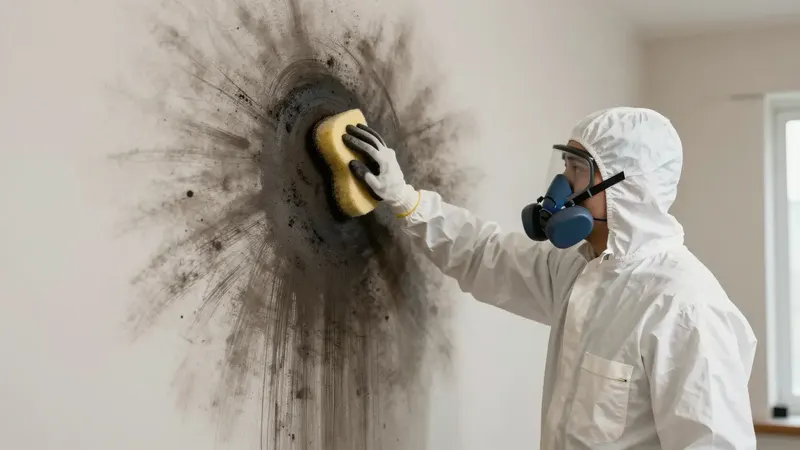
Humid summers and below-grade rooms create the conditions mold needs. After any leak, check behind drywall near the floor, under carpet and around the water heater and laundry area.
The EPA's guideline is that areas smaller than about 10 square feet can usually be cleaned by the homeowner once the leak is repaired. Larger patches or mold spreading into shared spaces are a job for mold removal specialists.
Immediate steps for Parkville residents
- Call 911 for fire, injury, the smell of gas or water climbing quickly indoors.
- If water or smoke might be reaching the unit next door, knock and let your neighbors know.
- Keep out of standing water in basements unless you know the electricity there is off.
- Check the Baltimore County emergency management page for NOAA weather alerts.
- Document the damage in photos and video, and keep a written list of what was lost.
- Speak with your insurer or agent; coverage depends on your specific policy, and outside flooding needs its own flood coverage.
Neighborhoods and nearby communities
Areas in and around Parkville that callers often mention include:
- Ridgeleigh
Nearby communities with their own pages (straight-line distance from Parkville):
Parkville restoration FAQs
Water from my townhome leaked into my neighbor's. What should we do?
Stop the source if you can, warn your neighbor and contact both insurers. Responsibility usually depends on where the leak began and on each policy, and fast drying limits damage on both sides of the wall.
How common are house fires in Baltimore County?
Baltimore County Fire Department figures for 2023 list 676 structure fires among 2,253 total fires. Working smoke alarms on every level and cleaning dryer vents are simple ways to lower the risk.
Did the 2018 flood declaration cover Parkville?
FEMA's DR-4376 covered Baltimore County for the severe storm and flooding of May 27 and 28, 2018. Declarations are county-wide and don't confirm flooding on any specific street.
Why does my basement get wet in heavy rain?
In a densely built area, runoff from roofs and pavement collects fast, and saturated soil pushes water through foundation cracks. Clean gutters, downspout extensions and a working sump pump help keep it out.
Restoration guides
- Water Damage Repair
- Emergency Water Removal
- Fire Damage Cleanup
- Soot Removal
- Basement Flood Cleanup
- Mold Removal