
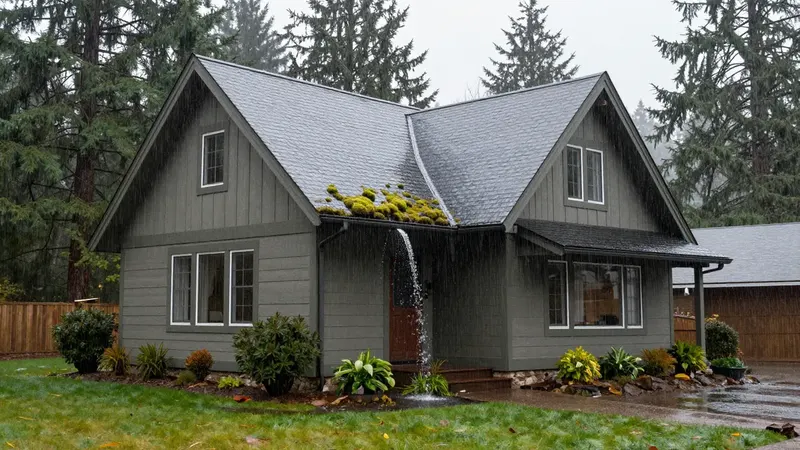
Grants Pass sits at about 960 feet in the Rogue Valley, where Interstate 5 and U.S. Route 199 meet and the Rogue River cuts through the middle of town past Riverside Park and the Caveman Bridge. Summers are hot and close to rainless, while the cool season can stack storm after storm on the same hillsides.
Our line is a referral service; Fire & Water Energy doesn't send its own crews. Ring (866) 937-3230 and we'll try to pair you with an independent restoration contractor that works in Josephine County; whether one is free depends on local providers. Before calling, Rogue Valley owners can skim how it works or our referral disclosure to see how matches happen.
Rogue Valley rain records, river history and dry summers
According to Wikipedia, the city collects roughly 31 inches of precipitation a year, and about three-quarters of it falls from November through March. December averages more than 6.5 inches, yet July and August each see well under half an inch. The single wettest month on record was December 1996, with 20.63 inches, and on October 29, 1950, more than five inches fell in one day.
The Rogue has a long record of high water here: a 1905 flood wiped out the old Grants Pass log dam. Since 2000, FEMA has included Josephine County in severe storm and flooding declarations in 2006 (DR-1632), twice in 2017 (DR-4296 and DR-4328), and in 2025 (DR-4881), plus the 2020 wildfires and straight-line winds declaration (DR-4562).
Water damage restoration in Grants Pass homes and shops
Because the rain comes in a concentrated winter burst, roof flashing, clogged gutters and saturated crawlspaces tend to fail in the same few months. A cold night can split an exposed hose bib or a supply line in an unheated garage, and a leaking water heater or washer hose can soak flooring at any time of year.
For water damage restoration in Grants Pass, a typical contractor stops the source, removes standing water with water extraction gear, maps moisture with meters, and sets up air movers and dehumidifiers for structural drying. Replacing drywall, trim or floors comes afterward as water damage repair.
Federal disaster declarations that included Josephine County
FEMA records show Josephine County was included in 5 major disaster declarations for weather or fire events from 2000 through 2026 (4 severe storm, 1 fire, by FEMA incident type). Declarations are made at the county level, so they do not mean every neighborhood in Grants Pass was affected. The most recent:
- 2025 – Severe Storms, Flooding, Landslides, and Mudslides (DR-4881)
- 2020 – Wildfires and Straight-line Winds (DR-4562)
- 2017 – Severe Winter Storms, Flooding, Landslides, and Mudslides (DR-4328)
- 2017 – Severe Winter Storm and Flooding (DR-4296)
- 2006 – Severe Storms, Flooding, Landslides, and Mudslides (DR-1632)
Source: OpenFEMA Disaster Declarations Summaries, retrieved 2026-10-10. Counts include major disaster (DR) declarations with hurricane, flood, severe storm, tropical storm, fire, tornado, coastal storm, winter or ice storm, mudslide and dam/levee incident types.
Water, fire or storm damage in Grants Pass?
Call (866) 937-3230 and tell us what happened at your Grants Pass property.
Smoke, soot and the southern Oregon fire season
The 2020 wildfire declaration that covered Josephine County is a reminder that the dry months here carry real fire risk. Smoke drifting into the valley can leave fine ash on window sills, in attics and inside HVAC returns, even when flames never come close.
After a house fire, contractors commonly secure the structure, haul out burned materials, clean soot from each surface with methods suited to it, and treat lingering odor with filtration and deodorizing. Our guides to fire damage cleanup and smoke damage cleanup go deeper.
When the Rogue rises: flood and storm cleanup
Lots near the riverbank and low ground around the parks are the first places to watch during long winter storms. The county's FEMA declarations also list landslides and mudslides, which matters for homes on the slopes around town, where saturated soil can push mud against walls or block drainage.
Floodwater from outdoors is treated as contaminated, so soaked carpet, pad and lower drywall are usually cut out rather than dried in place. See flood cleanup and storm damage cleanup for what that process tends to include.
Keeping mold out after a wet Josephine County winter
Months of damp weather followed by sudden warmth give mold an easy start in crawlspaces, behind baseboards and under sinks. If materials stay wet for more than a day or two, growth becomes likely, and cleaning alone won't hold unless the moisture source is fixed.
EPA guidance says a patch under about 10 square feet can often be handled by a homeowner, while larger areas, contamination in ducts or growth following sewage or flooding call for professionals. Containment and HEPA filtration are standard on bigger jobs; see mold remediation.
First moves for Grants Pass residents after damage
- Dial 911 for fire, injuries, a gas odor or downed power lines, and get out if the structure seems unsafe.
- Shut off the main water valve for plumbing leaks, and keep clear of standing water near outlets or appliances.
- Watch Josephine County and National Weather Service updates during river rises and fire season, and follow evacuation orders.
- Take photos of every damaged room and save receipts for emergency purchases before hauling debris to the curb. Whether a loss is covered depends on your own policy, so talk with your agent or insurer.
Picking an independent contractor in southern Oregon
Ask any company for its business details, proof of insurance and a written scope before work starts, and check whether your state or city requires a license for the work. Asking whether technicians hold IICRC certification is reasonable too. More on our Oregon service areas page.
Neighborhoods and nearby communities
Nearby communities with their own pages (straight-line distance from Grants Pass):
- Central Point · 22 mi
- White City · 24 mi
- Medford · 24 mi
- Eagle Point · 27 mi
- Ashland · 36 mi
- Roseburg · 54 mi
Grants Pass restoration FAQs
When is water damage most likely in Grants Pass?
Mostly November through March, when about three-quarters of the city's yearly precipitation falls. That is when roofs, gutters and crawlspaces get tested hardest. Summers are typically very dry, so warm-season leaks are more often plumbing or appliance failures.
Has the Rogue River flooded in Grants Pass before?
Yes. A flood in 1905 destroyed the original log dam at Grants Pass, and Josephine County has been included in several FEMA flood-related declarations since 2000, most recently in 2025. If you live near the river, keep an eye on forecasts during long winter storms.
Can wildfire smoke damage a home that never burned?
It can. Fine ash and smoke residue can settle in attics, ducts and soft furnishings during heavy smoke periods. Replacing HVAC filters and having a professional assess persistent odor or residue is a sensible step.
How do I get help with cleanup in Grants Pass?
Phone (866) 937-3230 and give a quick rundown of the leak, fire or flood. We will try to connect you with an independent contractor serving the area, though availability depends on local providers.
Restoration guides
- Water Damage Restoration
- Flood Cleanup
- Structural Drying
- Smoke Damage Cleanup
- Mold Remediation
- Storm Damage Cleanup