
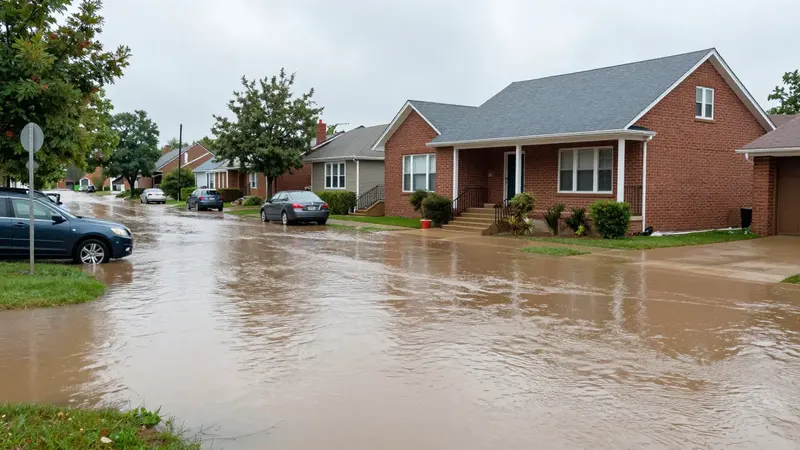
Monroe sits at the eastern end of the Snohomish River floodplain, close to where the Skykomish and Snoqualmie rivers join. The Skykomish wraps the city's southern and eastern edges, Woods Creek lies to the east, and neighborhoods climb to around 210 feet on Milwaukee Hill and the northern foothills. That mix of river bottom and hillside creates very different water problems from one block to the next.
Fire & Water Energy is a referral service, and it does not send its own workers anywhere. Call (866) 937-3230 and we'll try to reach an independent restoration contractor who takes work in Monroe and along US 2. Whether one is available depends on those independent companies. Questions about the arrangement are answered on how it works and in the referral disclosure.
Two rivers, foothill creeks and a wet maritime climate
Precipitation falls on about 177 days a year here, and the yearly total of around 48 inches beats Everett's 33. Snow is uncommon, averaging under 5 inches in recent normals, yet January 1950 delivered a record 60.4 inches along with a low of -3°F. The city's documented flood history goes back at least to February 1932, when a major flood left damage later repaired by the WPA.
Snohomish County has been named in 16 FEMA major disaster declarations since 2000. Recent ones include flooding and mudslides in 2014 (DR-4168), a severe windstorm in 2015 (DR-4242), storms with a tornado in 2019 (DR-4418), winter storms in 2021 and 2023 (DR-4593, DR-4682) and storms with flooding in 2026 (DR-4906). Locally, an EF0 tornado damaged RVs at a dealership on March 30, 2017.
Common water damage in Monroe homes
Months of steady rain test gutters, roof flashing and foundation drainage, especially on sloped lots draining toward French Creek and Woods Creek. More than 65 percent of homes are single-family houses, many in subdivisions built from the late 1960s onward, where aging water heaters, supply lines and original plumbing can fail. In older downtown buildings along Main and Lewis streets, roof and pipe leaks often go unnoticed until ceilings stain.
Monroe water damage restoration typically means finding and stopping the source, extracting water, checking moisture in subfloors and wall cavities and drying until readings are normal, then handling repairs. See our pages on water damage restoration and basement flood cleanup.
Federal disaster declarations that included Snohomish County
FEMA records show Snohomish County was included in 16 major disaster declarations for weather or fire events from 2000 through 2026 (12 severe storm, 3 flood, 1 mudslide/landslide, by FEMA incident type). Declarations are made at the county level, so they do not mean every neighborhood in Monroe was affected. The most recent:
- 2026 – Severe Storms, Straight-line Winds, Flooding, Landslides, and Mudslides (DR-4906)
- 2023 – Severe Winter Storm, Straight-line Winds, Flooding, Landslides, and Mudslides (DR-4682)
- 2021 – Severe Winter Storm, Straight-line Winds, Flooding, Landslides, and Mudslides (DR-4593)
- 2020 – Severe Storms, Flooding, Landslides, and Mudslides (DR-4539)
- 2019 – Severe Winter Storms, Straight-line Winds, Flooding, Landslides, Mudslides, Tornado (DR-4418)
- 2016 – Severe Storms, Straight-line Winds, Flooding, Landslides, and Mudslides (DR-4249)
Source: OpenFEMA Disaster Declarations Summaries, retrieved 2026-10-10. Counts include major disaster (DR) declarations with hurricane, flood, severe storm, tropical storm, fire, tornado, coastal storm, winter or ice storm, mudslide and dam/levee incident types.
Water, fire or storm damage in Monroe?
Call (866) 937-3230 and tell us what happened at your Monroe property.
A town shaped by fire, from downtown blocks to the condensery
Fire has altered Monroe more than once. On September 16, 1901, a blaze that started at the Odd Fellows hall wiped out the only complete block of businesses in town, and on March 23, 1944, fire destroyed the Carnation condensery; its 150-foot stack still stands downtown. Today the risks are mostly household ones, such as cooking, heating and electrical faults.
After a fire, contractors commonly stabilize the structure, clear debris, clean soot by material type and treat lingering odor, while also drying water left by firefighting. Explore fire damage cleanup and smoke odor removal.
Floodplain cleanup along the Skykomish
Lots close to the Skykomish and Woods Creek carry more river exposure, while hillside homes deal more with runoff and slides; many county declarations list landslides with flooding. River and surface water are treated as contaminated, so wet drywall, insulation and carpet pad are normally cut out and the framing cleaned and dried.
Read about flood damage restoration and storm damage cleanup for the full process.
Mold where rain falls 177 days a year
With so many damp, gray days, wet materials rarely dry by themselves, and crawlspaces, basements and closets on outside walls are frequent trouble spots. Remove the moisture source first. EPA guidance says homeowners can often clean mold patches under about 10 square feet; bigger areas, growth inside HVAC systems or mold tied to flood or sewage water warrant professional mold remediation with containment and HEPA filtration.
What to do first after damage in Monroe
- Call 911 for fires, injuries, gas leaks or rising water threatening people.
- Do not enter flooded rooms while the electricity may be live.
- If river water is rising, follow Snohomish County emergency instructions and move to higher ground.
- Take photos and video of every affected area before cleanup.
- Reach your insurance agent early. Coverage depends on the policy, and flood damage usually requires separate flood coverage.
Neighborhoods and nearby communities
Areas in and around Monroe that callers often mention include:
- Downtown
- Fryelands
- North Kelsey
- Lake Tye
- Park Place
Nearby communities with their own pages (straight-line distance from Monroe):
- Silver Firs · 9 mi
- Cottage Lake · 9 mi
- Mill Creek East · 10 mi
- Eastmont · 10 mi
- Mill Creek · 11 mi
- Woodinville · 11 mi
Monroe restoration FAQs
Which parts of Monroe are closest to the river?
The Skykomish River runs along the city's southern and eastern edges, and Woods Creek borders the east side. Homes in lower areas near those waterways are more exposed to flooding than homes on Milwaukee Hill and the northern foothills.
Does Monroe get much snow?
Not usually; recent normals put average snowfall under 5 inches a year. Still, January 1950 brought a record 60.4 inches, and Snohomish County was part of the 2009 record-snow declaration, so frozen pipes and roof loads are worth preparing for.
Has Monroe had earthquake damage?
Yes. The April 29, 1965 Puget Sound earthquake severely damaged the original Monroe High School. After any quake, check for broken water lines and gas leaks before re-entering.
Can you find someone to dry out my house after a Skykomish flood?
Call (866) 937-3230 and we'll try to locate an independent restoration contractor serving Monroe. During widespread flooding many homes need help at once, so availability is never guaranteed.
Restoration guides
- Flood Damage Restoration
- Water Damage Restoration
- Basement Flood Cleanup
- Storm Damage Cleanup
- Mold Remediation
- Fire Damage Cleanup