
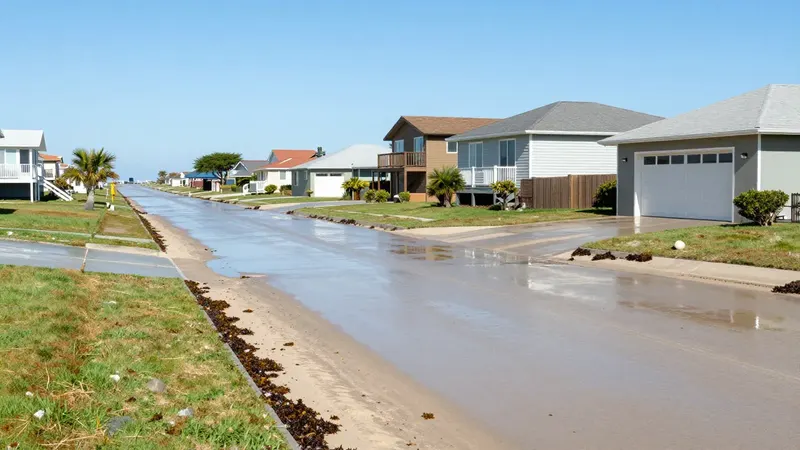
Hancock County's seat sits at about 23 feet above sea level, bounded by the Jourdan River on the north and open water on the east. Most of the federal disaster declarations for the county since 2000 trace back to tropical systems, from Isidore in 2002 to Tropical Storm Arthur in 2026.
Fire & Water Energy does not repair or clean homes; it is a referral service. When you call (866) 937-3230, we will try to connect you with an independent restoration contractor that serves Bay St. Louis, subject to which local companies are available. Details are on our how it works page.
Bay, sound and surge: the local hazard picture
Of the city's 26.6 square miles, almost 12 are water. That geography is the reason surge dominates local risk. Hurricane Camille's eye passed over neighboring Waveland on August 17, 1969, and on August 29, 2005, Hurricane Katrina made its final landfall just west of town at the mouth of the Pearl River, pushing a 28-foot surge. Arriving at high tide, the storm tide topped 30 feet and wrecked the US 90 bridge across the bay.
A ridge of about 25 feet along the old Highway 90, the Old Spanish Trail, on the western edge was spared that surge. Since then, Hancock County declarations have covered Gustav (2008), Isaac (2012), Nate (2017), Zeta (2020) and Ida (2021), along with a 2024 storm and tornado event and a 2026 winter storm.
Everyday leaks and water damage repair on the coast
Not every wet floor comes from a hurricane. Hot, humid summers keep air conditioning running much of the year, so overflowing condensate pans and frozen evaporator coils are frequent culprits. Salt air can also shorten the life of exterior fittings and roofing fasteners, leaving gaps for wind-driven rain.
Where a house is raised on piers, the plumbing under the floor is exposed and can crack during the rare hard freeze, like the one behind the 2026 winter declaration. When you need water damage restoration in Bay St. Louis, expect a contractor to remove water, dry the structure and confirm readings before any water damage repair. For quick removal, see emergency water removal.
Federal disaster declarations that included Hancock County
FEMA records show Hancock County was included in 13 major disaster declarations for weather or fire events from 2000 through 2026 (9 hurricane, 2 severe storm, 1 tropical storm, 1 winter storm, by FEMA incident type). Declarations are made at the county level, so they do not mean every neighborhood in Bay St. Louis was affected. The most recent:
- 2026 – Tropical Storm Arthur (DR-4930)
- 2026 – Severe Winter Storm (DR-4899)
- 2024 – Severe Storms, Straight-line Winds, Tornadoes, and Flooding (DR-4790)
- 2021 – Hurricane Ida (DR-4626)
- 2020 – Hurricane Zeta (DR-4576)
- 2017 – Hurricane Nate (DR-4350)
Source: OpenFEMA Disaster Declarations Summaries, retrieved 2026-10-10. Counts include major disaster (DR) declarations with hurricane, flood, severe storm, tropical storm, fire, tornado, coastal storm, winter or ice storm, mudslide and dam/levee incident types.
Water, fire or storm damage in Bay St. Louis?
Call (866) 937-3230 and tell us what happened at your Bay St. Louis property.
Fire and smoke damage in salt-air homes
Smoke residue is acidic, and in a humid coastal house it can tarnish metal and stain finishes quickly. Fast cleaning makes a real difference to what can be saved.
Restoration companies commonly secure the structure, remove burned debris, clean soot surface by surface, and treat odor in fabrics and HVAC systems. Our fire damage restoration page outlines the usual stages.
Hurricane and flood cleanup in Hancock County
Surge and floodwater carry sewage, fuel and debris, so contractors treat it as Category 3 contaminated water. That usually means removing drywall and insulation up to a set height above the waterline, cleaning and disinfecting, then drying the frame thoroughly.
Wind damage often happens alongside the flooding: roof sections lost, trees down and windows broken. Tarps and board-up limit further rain intrusion. Our hurricane damage cleanup and flood damage restoration pages explain more.
Mold after the water recedes
Humid subtropical air keeps indoor moisture high, so mold can spread quickly once materials are wet. Lowering humidity with dehumidifiers and removing soaked materials quickly limits growth.
EPA guidance says a homeowner can often clean an area under about 10 square feet; larger growth, or mold after contaminated floodwater, warrants professional remediation with containment. Learn more on mold remediation.
Safety and paperwork for Bay St. Louis residents
- Call 911 for emergencies such as fire, injuries or gas leaks.
- Do not wade through surge or floodwater; it can hide debris and live wires.
- Watch the City of Bay St. Louis Emergency Operations Center page and Hancock County officials for evacuation and re-entry updates.
- Document damage with photos and video before cleanup, and keep damaged items until your adjuster says otherwise.
- Wind and flood are often covered by separate policies; confirm what yours includes with your insurer.
Neighborhoods and nearby communities
Nearby communities with their own pages (straight-line distance from Bay St. Louis):
- Waveland · 3 mi
- Pass Christian · 5 mi
- Diamondhead · 6 mi
- Long Beach · 11 mi
- Gulfport · 15 mi
- Picayune · 26 mi
Bay St. Louis restoration FAQs
How high did Katrina's surge reach in Bay St. Louis?
Wikipedia reports a 28-foot surge where Katrina made final landfall just west of the city, with the storm tide passing 30 feet because it arrived at high tide. A ridge of about 25 feet along the old Highway 90 on the western edge was spared.
Where can I find local emergency information?
The City of Bay St. Louis website has an Emergency Operations Center page and links to the Region 9 hazard mitigation plan. Hancock County officials also issue evacuation and re-entry notices during storms.
Does homeowners insurance pay for storm surge damage?
Surge is generally treated as flooding, which standard homeowners policies often exclude. Many coastal owners carry separate flood coverage. Ask your agent which policy applies to your loss.
Can someone help with a raised home's water damage near Waveland or Diamondhead?
Call (866) 937-3230 and share your address. We will try to connect you with an independent contractor who works in your part of Hancock County, though availability varies.
Restoration guides
- Hurricane Damage Cleanup
- Flood Damage Restoration
- Emergency Water Removal
- Water Damage Repair
- Fire Damage Restoration
- Mold Remediation