
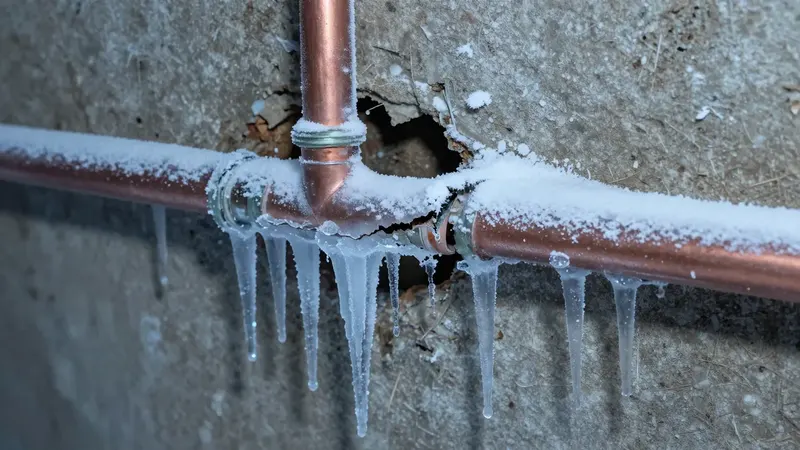
Lancaster spreads across the Antelope Valley in northern Los Angeles County, with the San Gabriel Mountains to the south and the Tehachapis to the northwest. The climate borders on arid, with normal yearly precipitation under 7 inches, yet the city averages roughly 68 mornings at or below freezing. That combination produces a different damage profile from the rest of the county.
Fire & Water Energy is a referral service with no crews or equipment of its own. A call to (866) 937-3230 lets us try to locate an independent restoration contractor working in Lancaster, though we cannot promise availability. See how matching works and read the referral disclosure.
Desert cold snaps, snow and rare cloudbursts
Temperatures drop to freezing or below from late November through late January, and the record low is 2 degrees, set on December 24, 1984. Snow is unusual but not unknown: January 1979 brought nearly 24 inches. Rain arrives seldom but sometimes hard, as on March 1, 1983, when 2.93 inches fell in a day, and January 1993 delivered 7.46 inches in a single month.
Los Angeles County has appeared in 14 FEMA major disaster declarations since 2000, including severe winter storm declarations in 2023 and 2024 and wildfire declarations in 2018, 2020 and 2025. The county's Ready LA County site lists extreme cold, debris and mudflows, flooding and wildfires among the hazards residents should plan for.
Split pipes and other indoor water problems
With so many freezing mornings, pipes in exterior walls, attics, garages and outdoor hose bibs are the classic Lancaster failure point; the damage often shows up when the line thaws midday. Evaporative coolers, water heaters and irrigation lines add their own leak risks, and a roof that sees little rain may not reveal worn flashing until a storm.
A contractor providing water damage restoration in Lancaster will generally shut off the source, measure moisture, remove ruined materials and dry with fans and dehumidifiers. For pipe breaks specifically, see burst pipe water damage; for rebuilding afterward, water damage repair.
Federal disaster declarations that included Los Angeles County
FEMA records show Los Angeles County was included in 14 major disaster declarations for weather or fire events from 2000 through 2026 (7 fire, 5 severe storm, 2 flood, by FEMA incident type). Declarations are made at the county level, so they do not mean every neighborhood in Lancaster was affected. The most recent:
- 2025 – Wildfires and Straight-line Winds (DR-4856)
- 2024 – Severe Winter Storms, Tornadoes, Flooding, Landslides, and Mudslides (DR-4769)
- 2023 – Severe Winter Storms, Straight-line Winds, Flooding, Landslides, and Mudslides (DR-4699)
- 2023 – Severe Winter Storms, Flooding, Landslides, and Mudslides (DR-4683)
- 2020 – Wildfires (DR-4569)
- 2018 – Wildfires (DR-4407)
Source: OpenFEMA Disaster Declarations Summaries, retrieved 2026-10-10. Counts include major disaster (DR) declarations with hurricane, flood, severe storm, tropical storm, fire, tornado, coastal storm, winter or ice storm, mudslide and dam/levee incident types.
Water, fire or storm damage in Lancaster?
Call (866) 937-3230 and tell us what happened at your Lancaster property.
Fire, heat and smoke drifting off the mountains
Summers are hot and nearly rainless, and the record high hit 115 degrees on June 30, 2013. Dry shrubland covers most of the surrounding land, so brush fires and smoke from mountain wildfires are part of the summer and fall picture. Household fires add soot and odor regardless of season.
Fire damage cleanup usually begins with securing the structure and removing debris, followed by cleaning surfaces and HVAC systems. Light smoke infiltration may only need smoke damage cleanup.
Flash runoff on hard desert ground
Thunderstorms mainly develop from July to September and can dump rain onto hard soil that absorbs little. Water then sheets across lots and into garages or low rooms. Treat that runoff as dirty water. Flood cleanup generally means extracting water and silt, cutting out soaked drywall, disinfecting and drying.
Does mold grow in the dry Antelope Valley?
Dry outdoor air helps, but mold only needs a damp material indoors. A slow leak behind a cabinet, a wet wall after a frozen pipe or a swamp cooler that overflows can all support growth. The EPA notes that areas under about 10 square feet are usually manageable by a homeowner; bigger problems call for mold remediation with containment.
Lancaster safety steps and records
- Dial 911 for fire, injuries, a gas odor or anyone in danger from water.
- Know where your main water shutoff is before winter; close it quickly if a pipe splits.
- Sign up for Alert LA County through Ready LA County.
- Photograph damage and save broken parts, such as a cracked fitting, for your adjuster.
- Contact your insurer or agent promptly; coverage depends on your policy terms.
More cities appear on our California service area page.
Neighborhoods and nearby communities
Areas in and around Lancaster that callers often mention include:
- Downtown Lancaster
- Old Town
- The BLVD
- West Lancaster
Nearby communities with their own pages (straight-line distance from Lancaster):
Lancaster restoration FAQs
How often do pipes freeze in Lancaster?
The city averages about 68 mornings a year at or below freezing, mostly from late November to late January. Insulating exposed pipes, disconnecting garden hoses and keeping garages closed on cold nights all help.
Can Lancaster really flood with under 7 inches of rain a year?
Yes. Rain often comes in short, heavy bursts, like the 2.93 inches recorded on March 1, 1983, and desert soil absorbs little. Runoff can collect quickly in low areas and garages.
Does a solar roof change anything after a leak?
New Lancaster homes built since 2014 must have solar panels, and mounting points are one more place water can enter. If a leak appears near panels, ask whether the roofer or solar installer should inspect before interior repairs are closed up.
Which alert service covers Lancaster evacuations?
Los Angeles County uses Alert LA County, which you can sign up for through ready.lacounty.gov. It covers evacuation orders and other urgent notices.
Will someone from Fire & Water Energy fix my Lancaster house?
No. Our role ends at the referral: we try to connect you with an independent contractor serving the Antelope Valley, and you work out the scope and terms with them.
Restoration guides
- Burst Pipe Water Damage
- Water Damage Restoration
- Water Damage Repair
- Fire Damage Cleanup
- Flood Cleanup
- Mold Remediation