
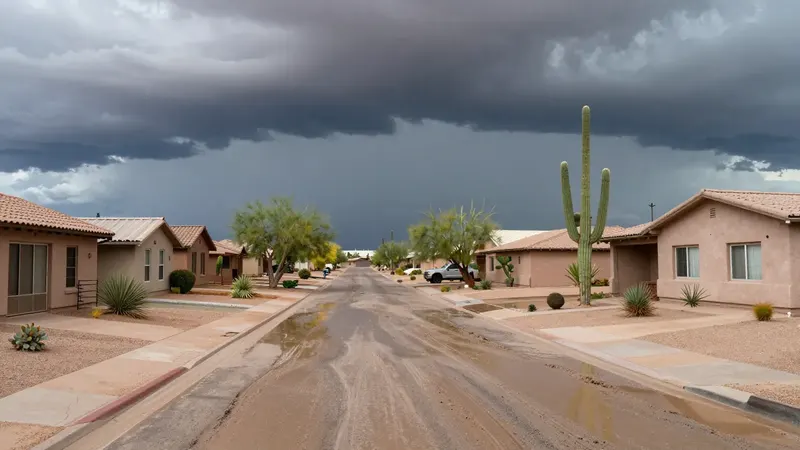
Apache Junction spreads across the far eastern end of the Valley, with Mesa on its western border and the Goldfield Mountains to the north. Most of the city lies in Pinal County, while a small western slice crosses into Maricopa County. Homes range from site-built houses to large manufactured-home and senior communities, and each type reacts a little differently to leaks, storms and fire.
We run a referral line here at Fire & Water Energy; the cleanup itself is done by someone else. When you phone (866) 937-3230, we'll try to link you with an independent contractor who works in your part of town. Whether someone can take the job depends on local providers, and the how it works page explains the process.
Desert heat, mountain runoff and summer cloudbursts
Local weather records put average yearly precipitation at 12.55 inches spread over about 40 rainy days. August is typically the wettest month at around 1.5 inches, with July and September not far behind, so the heaviest downpours land during the hottest part of the year.
Temperature swings are wide. July afternoons average about 105°F and the record high is 119°F, yet the thermometer fell to 17°F on January 14, 2007. Pinal County was included in FEMA severe storm and flooding declarations in 2000 (DR-1347), 2005 (DR-1586) and 2006 (DR-1660).
Plumbing failures and water damage restoration in Apache Junction
Day to day, most water losses here start indoors. Supply lines under sinks, aging water heaters, washer hoses and evaporative or refrigerated cooling systems can all leak quietly for days. In manufactured homes, water often spreads under the floor decking where nobody sees it until the floor softens.
Freezes are uncommon but real, so pipes in exposed crawlspaces or along exterior walls deserve attention on the coldest nights. A typical contractor will find and stop the source, extract standing water, measure moisture behind walls and under flooring, then dry the structure before any water damage repair begins.
Federal disaster declarations that included Pinal County
FEMA records show Pinal County was included in 3 major disaster declarations for weather or fire events from 2000 through 2026 (3 severe storm, by FEMA incident type). Declarations are made at the county level, so they do not mean every neighborhood in Apache Junction was affected. The most recent:
- 2006 – Severe Storms and Flooding (DR-1660)
- 2005 – Severe Storms and Flooding (DR-1586)
- 2000 – Severe Storms and Flooding (DR-1347)
Source: OpenFEMA Disaster Declarations Summaries, retrieved 2026-10-10. Counts include major disaster (DR) declarations with hurricane, flood, severe storm, tropical storm, fire, tornado, coastal storm, winter or ice storm, mudslide and dam/levee incident types.
Water, fire or storm damage in Apache Junction?
Call (866) 937-3230 and tell us what happened at your Apache Junction property.
Smoke, soot and fire cleanup in the foothills
Fire is part of local history: the Apacheland movie set, opened in 1960, was largely destroyed by fire in 1969. Today, house fires usually begin with cooking, dryers, heaters or wiring, and the long dry stretches before summer storms leave brush and yard debris ready to burn.
After a fire, a reputable company will usually secure the building, remove charred materials, clean soot from walls and belongings, and treat lingering odor. Manufactured homes can fill with smoke quickly, so ask whether the contractor has handled that construction type. See fire damage restoration and smoke damage cleanup for what each step involves.
Storm runoff and flood cleanup near the Superstitions
With mountains rising to the east and north, intense summer cells can send water across desert ground that absorbs very little. Low driveways, carports and units set close to grade are the most likely to take on water or mud.
Anything that washed in from the yard or street should be handled as dirty water. Contractors commonly remove soaked insulation, carpet and lower drywall, clean and disinfect, then dry with dehumidifiers and air movers. Wind damage to roofs, skirting and awnings falls under storm damage cleanup, while mud and silt removal is covered on our flood cleanup page.
Why mold still shows up in a dry climate
Low humidity dries exposed surfaces fast, but a slow leak inside a cabinet, wall cavity or under a manufactured home's floor can stay damp for weeks. Monsoon humidity adds to the problem during the same months that rain is most likely.
The EPA suggests that a homeowner can often handle mold covering less than about 10 square feet with proper protection. Larger areas, growth inside HVAC ducts, or mold that follows dirty water usually call for mold remediation with containment and air filtration.
First moves for Apache Junction households
- Dial 911 for any fire, injury, gas odor or person in danger, and get out first.
- Stay off flooded roads and out of running water in washes or low crossings.
- Switch off power to wet areas only if you can reach the panel safely from a dry spot.
- Close the main water valve when a pipe or fixture is the source.
- Photograph each room and list damaged items before anything is thrown out.
- What your policy pays for depends on its terms; check with your insurer or agent.
Neighborhoods and nearby communities
Nearby communities with their own pages (straight-line distance from Apache Junction):
- Queen Creek · 12 mi
- Gilbert · 14 mi
- San Tan Valley · 16 mi
- Mesa · 16 mi
- Gold Canyon · 16 mi
- Fountain Hills · 17 mi
Apache Junction restoration FAQs
When is flood risk highest in Apache Junction?
July, August and September bring the largest share of the year's rain, often as short, heavy storms. Those months are when runoff from desert ground and nearby slopes is most likely to reach homes and roads.
Do pipes really freeze here?
It does not happen often, but the area has recorded a low of 17°F and January nights average close to freezing. Insulating exposed lines, especially under manufactured homes, is a cheap precaution.
Part of the city is in Maricopa County. Does that matter?
It can matter for which county emergency office issues alerts and handles disaster programs. Most of the city is in Pinal County, so check which county your address falls in before a storm season.
Can you help callers in Gold Canyon or Mesa too?
Yes. We take calls from Gold Canyon, Mesa, Queen Creek and nearby East Valley communities. Whether an independent provider is available depends on who is working in that area at the time.
Restoration guides
- Water Damage Restoration
- Water Extraction
- Flood Cleanup
- Fire Damage Restoration
- Mold Remediation
- Storm Damage Cleanup